
Categories
Activities Seminar and workshop

Online Focus Group Discussion MoTLab-LPIK-ITB: Technology Commercialization Management in Higher Education

BANDUNG, mot.sbm.itb.ac.id – The Research, Innovation, and Commercialization Institute (LPIK) ITB, in collaboration with the Technology Management Laboratory at SBM ITB, conducted an online Focus Group Discussion on the theme of “Technology Commercialization Management in Higher Education.” The event took place on Wednesday, July 12, 2023, from 09:00 to 12:00 WIB (Indonesia time) via the Zoom Meeting platform, with live streaming available on the YouTube channel https://www.youtube.com/live/fRe9ZEpZAm0?feature=share.

The Focus Group Discussion featured relevant speakers, including the CEO of PT. Rekacipta Inovasi ITB, the Secretary of the Technology Transfer Department at LPIK ITB, the Commissioner of PT. Rekacipta Inovasi ITB, the Director of BPUDL-ITB, the Director of PUI UGM, the Head of LKST IPB University, inventors, investors (MDI Telkom), representatives from SMEs and startups such as Lintasarta and Kazee, large corporations (SOEs and private), as well as government representatives.

The event was opened by a representative from LPIK ITB, Mr. Arif Sasongko, who provided discussion materials regarding the importance of collaboration with industries and the need for research sandboxing. “Collaboration with industries and research sandboxing efforts are challenges that need to be discussed in this forum.”

Rofiq Iqbal, Ph.D., the Secretary of the Technology Transfer Department, LPIK ITB, presented the management of technology commercialization resulting from research at ITB through LPIK ITB.

The commercialization of technology is a crucial aspect of national progress. As research centers, higher education institutions have great potential to contribute through the commercialization of research products. However, continuous efforts are needed to improve the effectiveness of the commercialization process in higher education.

The Director of Agency for University Business and Endowment Fund Management (BPUDL) ITB, Deddy P. Koesridartoto, Ph.D.,  highlighted the overlapping schemes of campus research commercialization that need better orchestration. “Collaboration among research commercialization initiatives in ITB, as already carried out by PT. Rekacipta Inovasi ITB and LPIK, needs to be well-managed.”, said the Director.

Deddy P. Koesridartoto, Ph.D., the Director of BPUDL ITB, presented the role of BPUDL ITB in supporting technology commercialization at ITB.

During the event, discussions were initiated with narrations from actors or institutions involved in technology commercialization in higher education, including representatives from ITB, IPB, UGM, and responses from inventors, investors, industries, and companies.

Prof. Erika Budiarti Laconi, the Head of LKST IPB University, presented IPB University’s efforts in commercialization with a one-stop approach, where IPB facilitates all commercialization endeavors. “At IPB, no lecturer works alone; everything goes through LKST IPB University,” said Prof. Erika.

Dr. Hargo Utomo, the Director of PUI UGM, added that understanding market needs and behaviors is an important factor in commercialization efforts. “The commercialization of technological innovation relies more on the ‘art’ rather than the ‘science,’.”, said Dr. Hargo.

Prof. Erika Budiarti Laconi, Head of LKST, IPB University, presented the research commercialization management at IPB University.

In this Focus Group Discussion, valuable insights and solutions are expected to be obtained to enhance the effectiveness of technology commercialization in higher education, thereby positively impacting innovation progress in Indonesia. The moderator, Dedy Sushandoyo, Ph.D., from the MoT Lab made several notes. First, the importance of good governance and totality in technology commercialization management, the need to understand and follow market potential/demand, the importance of support for researchers, the need for a commercialization playbook, sandboxing in Science Techno Park, and sustainable cooperation and communication with industries.

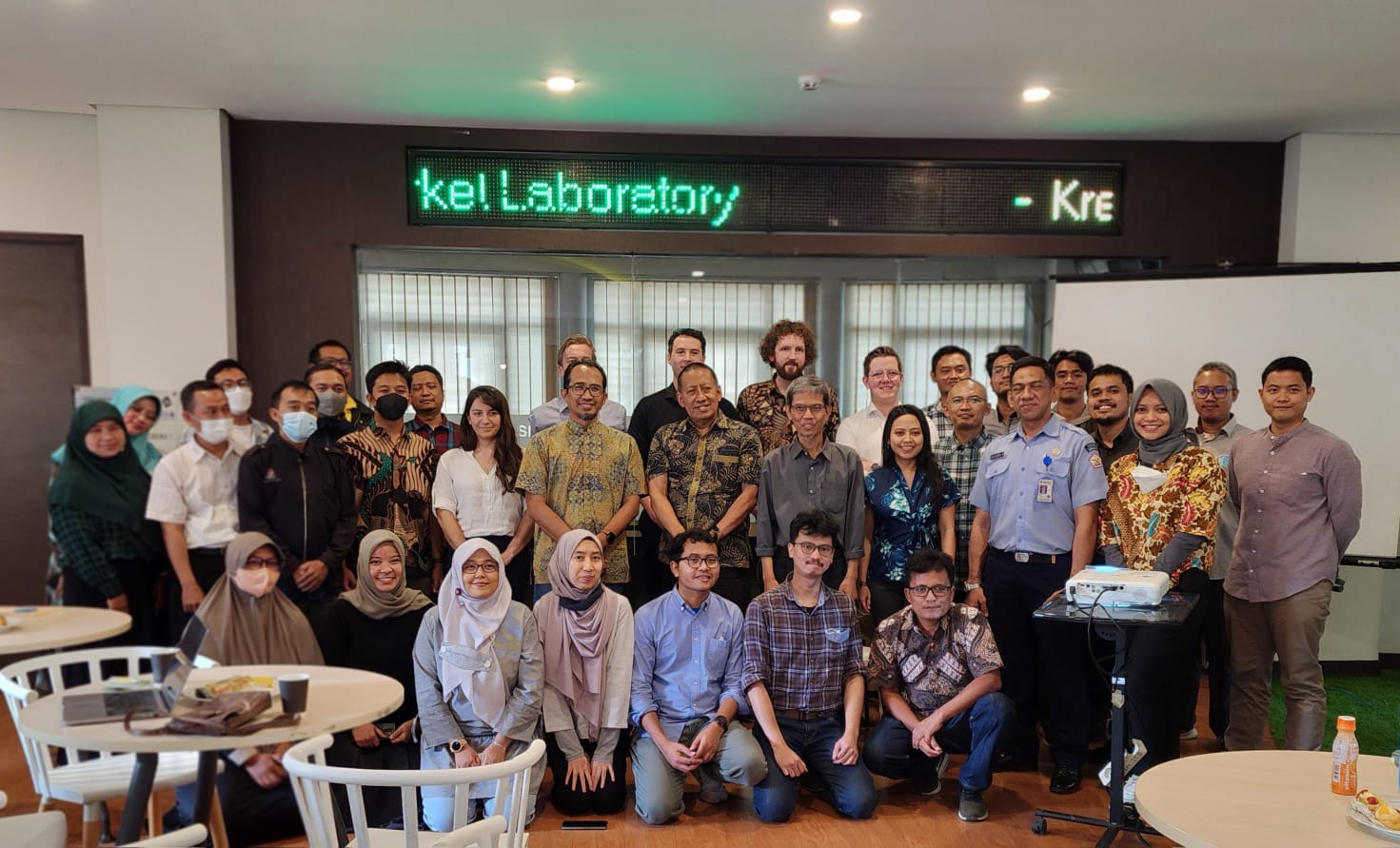
Group photo of the Online Focus Group Discussion participants: Technology Commercialization Management in Higher Education.

Reporter: Anisa Azizah

Editor: Uruqul Nadhif

Categories
Activities Industry visit

SBM-ITB Civitas Pays a Visit to the Local Automotive Industry, FIN Komodo

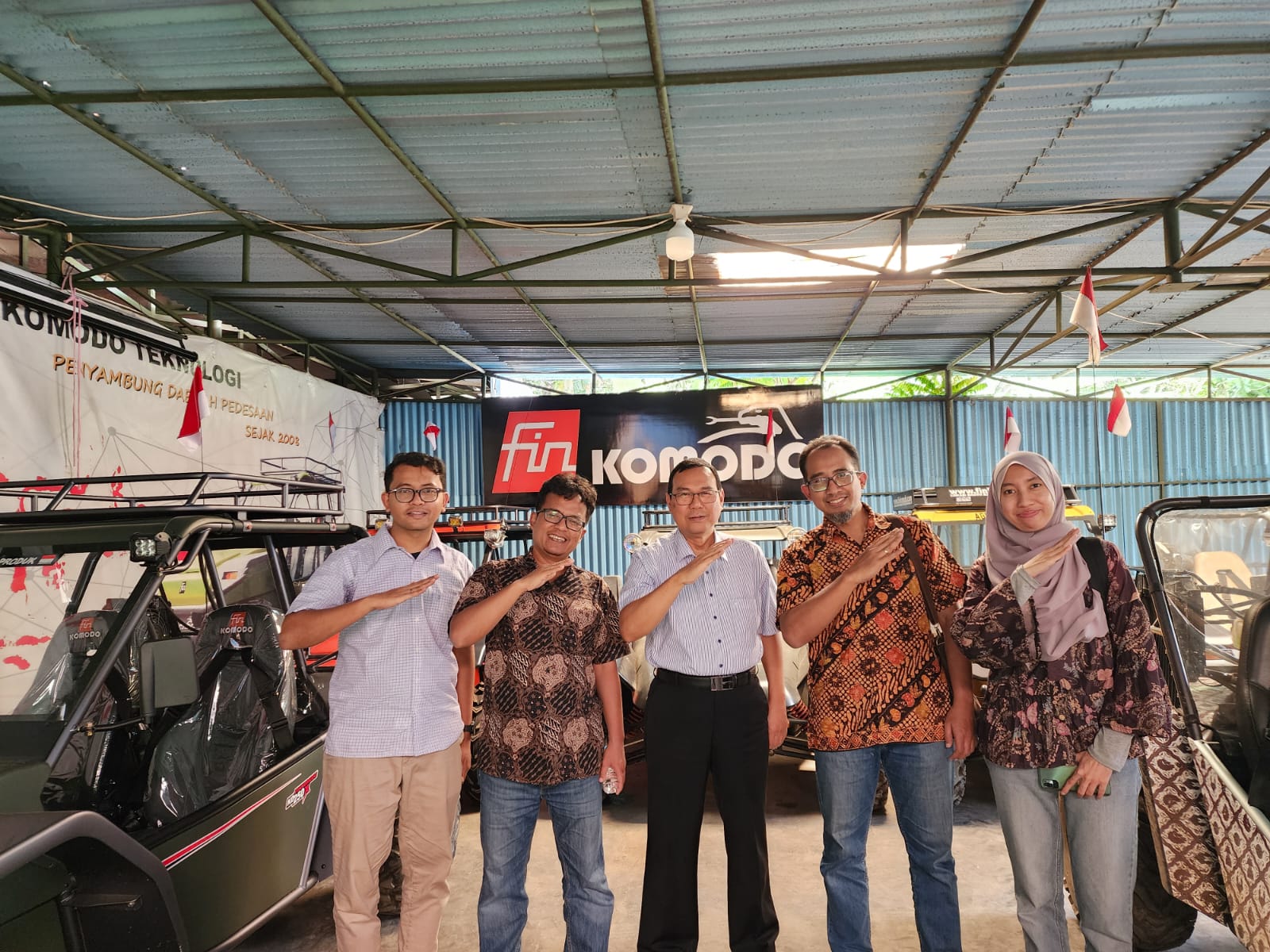
CIMAHI, mot.sbm.itb.ac.id – The academic community of the School of Business and Management Institut Teknologi Bandung (SBM-ITB) who are members of the Management of Technology Laboratory (MoT Lab) made an industrial visit to the local automotive company FIN Komodo this afternoon (16/5/2023). This company is located in Cimahi City, West Java. This visit is intended as an effort to understand the practice of domestic technology-based industries, specifically the automotive industry.

Through this visit, it is hoped that we can understand the dynamics of the automotive industry, especially the domestic industry”, said Dr. Eko Agus Prasetio, SBM-ITB innovation management lecturer who led this visit.

Photo with Ir. Ibnu Susilo, Founder of FIN Komodo

FIN Komodo is a multi-purpose offroad vehicle that is made and developed entirely 100% from national resources, established in 2005. This company was founded as a principal company, which is independent in designing, manufacturing, and developing its own products. This vehicle is specifically designed for off-road use in accordance with the natural conditions of Indonesia with the support of spare parts available on the market which are relatively affordable, easy maintenance and provide optimum comfort and safety.

Dr. Eko Agus Prasetio with a FIN Komodo vehicle

This vehicle with the name FIN Komodo is the result of its own research and development, has been tested since 2008, and has entered the market in stages. In 2013 mass production began with 120 units per year, and in 2020 it was increased to 1000 units per year. Komodo FIN buyers are not only in Indonesia, reaching Malaysia and even the farthest buyers are from Africa.

Dedy Sushandoyo, PhD. conducted an interview with Ir. Ibnu Susilo, founder of FIN Komodo

FIN Komodo implements a blue ocean strategy with a focus on the market for areas with poor infrastructure. The purpose of FIN Komodo is to build Indonesia’s technological culture by creating an independent automotive industry. “Why ‘culture’? Capability in technology is like a culture that has been formed for a long time and cannot be formed instantly by simply adopting it. In developing technology, it is carried out in stages, step-by-step.” said Ir. Ibnu Susilo, founder of FIN Komodo.

Test drive the Komodo FIN vehicle

During this visit, the SBM-ITB community members consisted of members of the SBM-ITB MoT Lab, namely Dr. Eko Agus Prasetio, Dedy Sushandoyo, PhD., Uruqul Nadhif Dzakiy, MT., and Lely Anggarini, MSM. who is a research assistant lecturer. Apart from conducting interviews, we had the opportunity to test drive the FIN Komodo vehicle. It is hoped that from this visit we can take lessons learned so that we can use them for research and teaching.

Through this visit, we hope that we can take lessons learned from local industrial development practices that can survive in the midst of intense competition like FIN Komodo and then serve as a source for our research or teaching in class.”, concluded Dedy Sushandoyo, PhD. a People and Knowledge Management (PKM) SBM-ITB lecturer.


Categories
Activities Seminar and workshop

MoTLab SBM-ITB Held Book Review of Technology Transfer for Innovation

Bandung, mot.sbm.itb.ac.id – Management of Technology Laboratory School of Business and Management Institut Teknologi Bandung (MoT Lab SBM-ITB) held a book review entitled “Transfer Teknologi untuk Inovasi: dari Riset ke Industri”. The event which was held at the Kresna SBM-ITB Lobby was attended by the authors, namely Dr.rer.pol. Eko Agus Prasetio, Dedy Sushandoyo, PhD, and Uruqul Nadhif Dzakiy, MT. All three are researchers at the SBM-ITB Management of Technology Laboratory (MoT Lab). This event was opened by Prof. Pulung Nurprasetio as Acting Deputy Dean of Resources of SBM-ITB and also presented two important speakers namely Ir. Ibnu Susilo (Founder & CEO of FIN Komodo) and Joko Sarwono, PhD. (Chairman of LPIK-ITB).

Book

“We hope that writing this book is for the greater good of the future and can also create a multiplier effect”, hoped Pulung to open this event.


Technology Transfer Through Three Channels

At the beginning of the event, the three book authors took turns giving brief explanations regarding the description of the book. The first author, Eko Agus Prasetio, gave an explanation regarding the urgency of technology transfer for innovation, followed by Uruqul Nadhif who gave an explanation of how this technology transfer initiation was carried out in Indonesia by raising several case studies in Indonesia such as FIN Komodo, Katalis Merah Putih, Vent-I , microcapsule, and the development of KF-X/IF-X. Finally, Dedy Sushandoyo gave an explanation regarding lessons that can be taken (lesson-learned) from the story of technology transfer from research to industry.

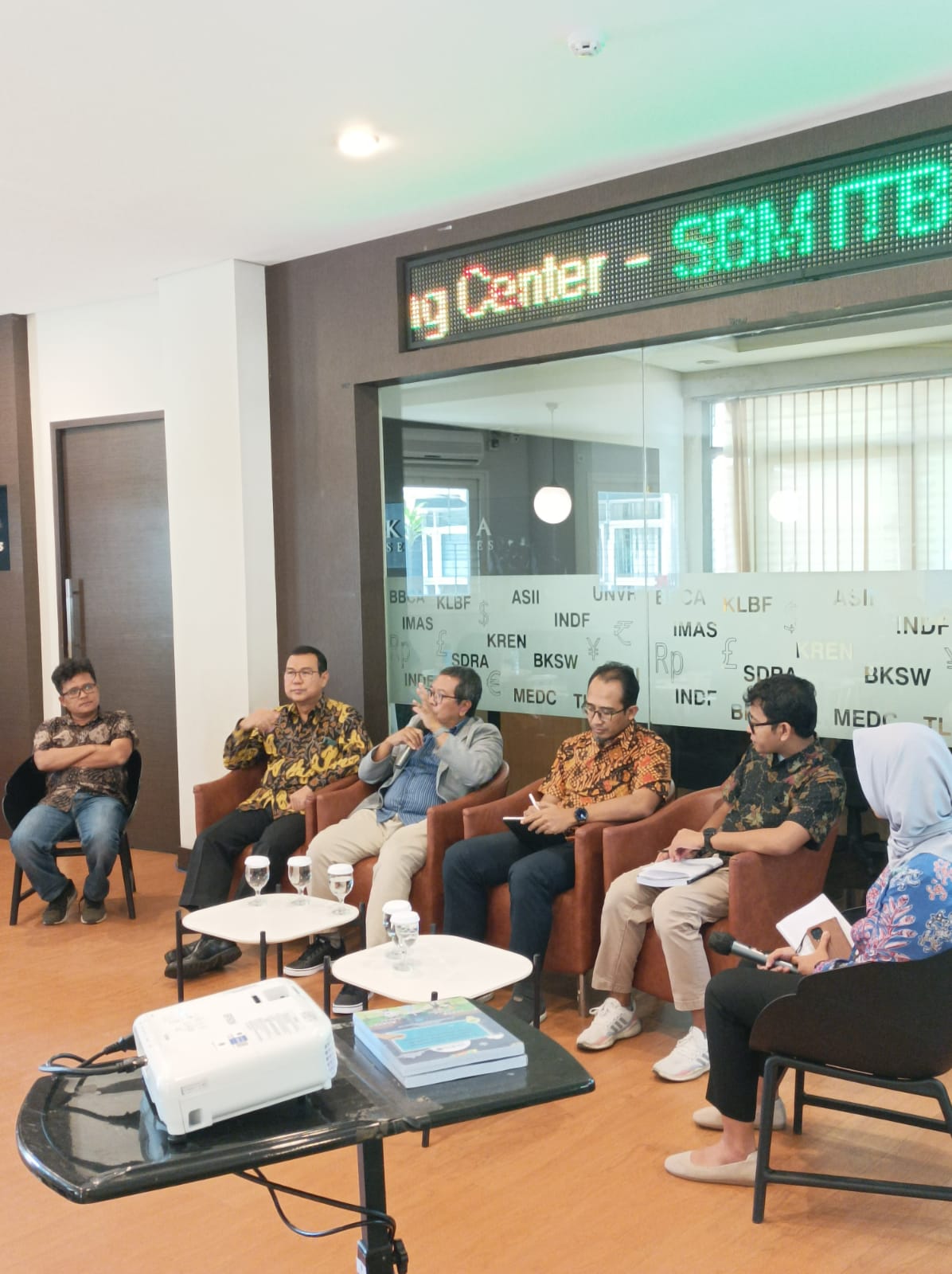
Presentation from the authors
(Dedy Sushandoyo-Eko Agus Prasetio – Uruqul Nadhif Dzakiy, from left to right)

The first speaker, Eko Agus Prasetio, explained an overview of the book where the idea for this book was compiled before the pandemic and was set for the public. In the book, we describe various case studies ranging from technology transfer carried out in-house by industry, technology transfer for institutional strengthening, and technology transfer carried out by universities. “In this book, we deliberately take three cases of technology transfer from several channels, either originating from in-house developed industries, technology transfers carried out to strengthen institutions, or technology transfers carried out by universities.”, said Eko.


Even so, this book still has homework to improve its content, namely by forming a framework on the pattern of technology transfer from the three types of channels. This book has not reached that stage due to time considerations. “We still have homework to improve this book by developing a technology transfer framework from in-house development, university-developed technology, and advanced engineering”, said Dedy.


Lesson from FIN Komodo

After the presentation session from the panelists ended, the event continued with a sharing session from the Founder and CEO of FIN Komodo, Ir Ibnu Susilo. FIN Komodo is a local automotive company located in Cimahi City, West Java, which produces off-road cars. In his presentation, Ibnu Susilo revealed that the idea behind developing the Komodo fin was motivated by the idea of connecting villages through the development of a vehicle that is as tough as a jeep and as comfortable as a sedan. At the beginning of development, Ibnu revealed that in the early days it was difficult to get financing from the Bank which at that time was refused. Luckily he got a project that could help with initial funding. “To fund initial prototype development, I worked on an aircraft parts development project in Malaysia. It was that capital that helped in the early days of developing FIN Komodo”, said Ibnu.

Ibnu Susilo, Founder and CEO FIN Komodo

Ibnu said that the important thing in industrial development is the brainware component that lies in the human being. That’s why at the beginning, Ibnu through FIN fostered up to dozens of SMEs in order to be able to supply the development of the Komodo FIN to the production stage. Currently, this company is 17 years old where the car being developed has entered its fifth generation since 2005 when it was first developed. “The development of technology-based industries lies in the people or the brainware”, added Ibnu.

Chairman LPIK-ITB, Joko Sarwono, PhD. was giving a presentation

The next speaker is Joko Sarwono, PhD. who is the chairman of the Institute for Innovation and Entrepreneurship Development (LPIK) ITB. He told about the challenges of developing research and innovation on campus by taking best practices from the Innovation and Entrepreneurship Development Institute (LPIK). He revealed that LPIK implements 3 focuses, namely innovation research as measured by the level of technology maturity (Technology Readiness Level-TRL), entrepreneurship development, and technology transfer office (TTO). Furthermore, Joko explained the obstacles to innovation in higher education, namely on the side of being too focused on quantity and regulations that do not support it.


One of the obstacles to innovation in higher education is because the size of innovation is still limited to the KPI (Key Performance Index) in terms of quantity. Apart from that, the regulations are not impartial. For example, ITB has been developing electric cars since 2010 but until now it cannot be said to be successful because support such as regulations is not sufficient.”, said Joko.

Photo session with the participants

This event was attended by many parties from SBM-ITB and externally. Several ITB professors attended this event such as Prof. Togar Simatupang (Professor of SBM-ITB supply chain), Prof. Aurik Gustomo (Professor of Human Capital Management SBM-ITB), Prof. Dermawan Wibisono (Professor of Operations and Performance Management at SBM-ITB), and Prof. Wawan Dhewanto (Professor of Entrepreneurship at SBM-ITB). The event was held in collaboration with MoTLab SBM-ITB and Human Capital Development SBM-ITB.

Categories
Activities Event

MoT Lab SBM-ITB Hosted Mini-Lecture with the Researchers from Twente University

BANDUNG, mot.sbm.itb.ac.id – Management of Technology Laboratory, School of Business and Management Bandung Institute of Technology (MoT Lab SBM-ITB) held a mini-lecture with researchers from the University of Twente, Netherlands. This event was held at the Kresna Lobby SBM-ITB on 11 January 2023. The event was welcomed by the Director of the MoT Lab SBM-ITB, Dr.rer.pol. Eko Agus Prasetio, MBA and then opened by Acting Vice Dean of Resources SBM-ITB, Dr. Ir. Ignatius Pulung Nurprasetio, M.SME. The lecture topic was “The Role of Technology in Addressing Societal Challenges” and was presented in English.

Amalia Suryani delivered a presentation about energy access in Indonesia.

Amalia Suryani, a researcher from the University of Twente, gave a presentation entitled “Co-creation for technological innovations in energy access, A transdisciplinary approach”. She explained about microgrids for energy access. A microgrid is an integrated energy system with three key elements (generation, storage, load): locally driven, distributed resources, and isolated or connected to the grid. Microgrids can supply electricity to a group of households, public facilities, and/or businesses. The speaker also gave his presentation regarding microgrids in Indonesia.

Maarten Appelman gave a presentation about the philosophy of technology.

Maarten Appelman, who is also a researcher from the University of Twente, in his presentation entitled “Philosophy of Technology, taking responsibility in a technological age”, cited the views of the famous philosopher Martin Heidegger. According to Heidegger, it is very important to understand how modern technology has changed our view of nature, and he fears that it will also make us see other humans as the same fixed stock. There is an intrinsic value to nature and people, and if technology has made us see nature as something we must defend, then we should be keenly aware that we might as well do the same for humans. Many philosophers have argued that Heidegger went overboard with this statement, but if we look now, some 60 years later, we can argue that he was quite right on this point.

Photo session with all participants

The SBM-ITB MoT Lab, in this event, conveyed to the participants that they had just published a book entitled “Transfer of Technology and Innovation for Business Transformation”. The authors of this book are SBM-ITB MoT Lab members, namely Eko Agus Prasetio, Uruqul Nadhif Dzakiy, and Dedy Sushandoyo. This event was attended by more than 50 people, both offline and online.


Reporter: Uruqul Nadhif Dzakiy

Categories
Activities Event News

MoTLab Hosted Knowledge Cafe for Dissemination of Research Results from the Facebook Research Grant Awardees

BANDUNG, mot.sbm.itb.ac.id – Management of Technology Laboratory School of Business and Management, Institut Teknologi Bandung (MoT Lab SBM-ITB) in collaboration with the SBM-ITB Master of Science Management Study Program and Doctor of Science in Management (MSM-DSM) held a Knowledge Cafe on Tuesday (13/12/22) at the Kresna Lobby SBM-ITB . This event was held to disseminate the research results of the SBM-ITB academic community to the broader community. At the December 2022 edition of the Knowledge Cafe, the topic was “Business Agility During the Pandemic Era” presented by research grant awardees from Facebook (Meta), namely Dr.rer.pol. Eko Agus Prasetio, Dedy Sushandoyo, PhD., and Dr. Eng. Ayu Purwarianti.

The competitive research was one of five (5) winners out of 189 proposals from 39 countries for proposals funded by Facebook (Meta). The ITB researcher raised this research topic by tracing how agile business actors were during the COVID-19 pandemic. This research is motivated by the domino effect caused by the COVID-19 pandemic, which has forced many small and medium businesses to operate online. This research is divided into three approaches: qualitative, quantitative, and technical.

Prof. Tjandra opened the event

Knowledge Cafe event moderated by Dita Novizayanti, MSM. of the research team, opened by Plt. Deputy Dean for Academic Affairs, namely Prof. Tjandra Anggraini. In his remarks, Prof. Tjandra appreciated this event and was very impressed with the achievements of the research grant awardees from Facebook. He especially hoped that this dissemination event could motivate the participants who attended to be encouraged to apply for a similar research grant. “Hopefully, the sharing provided by the resource persons can motivate all of us to try for research project proposals by looking at the trick,” hoped Prof. Tjandra.

Presentation of Three Research Approaches

After the remarks, the event continued with presentations from each research team coordinator. First, Dr.rer.pol. Agus Prasetio, MBA, gave a presentation on the quantitative research approach. In his presentation, he pointed out that implementing operational agility in a business is proven to increase customer value results only when digitalization is implemented. This relationship can be strengthened by increasing engagement with local tourism communities (POKDARWIS). Implementing customer agility improves customer value outcomes only when a high degree of digitization is implemented. This relationship can be strengthened by increasing engagement with the POKDARWIS.

From these findings, it is suggested that homestay business actors collaborate with POKDARWIS in each region. Specifically, in the case of areas with low potential for digitization implementation, procedures to maximize operational agility are required. Meanwhile, in the case of areas with high potential for digitalization, techniques are needed to strengthen customer operations and agility.

Dr.rer.pol. Eko Agus Prasetio delivered an opening presentation

Second, Dedy Sushandoyo, PhD. for a qualitative approach. In his presentation, he explained that this research investigates how big data and organizational processes affect a company’s business agility. The business agility referred to in this research is a company’s ability to improve product performance and create new businesses. This research takes case studies at four startup companies as case studies, namely eFishery, Credibook, Kazee and Prosa.ai, and a survey of homestay owners and managers in Indonesia in the 2019-2021 period with 350 respondents.

The findings from this research indicate that startups with a middle to lower target market need more data from non-application instruments than application data. Big data generally affect organizational processes (Organizational Process), and these administrative processes affect business agility (Business Agility). In addition, the involvement of top management was also found to affect business agility, specifically how companies can create new business.

The second presentation was from Dedy Sushandoyo, PhD.

This study’s results suggest that company management can determine a big data strategy by considering the functions and characteristics of the application and non-application data. This determination can be based on the company’s need to create a new business or improve product quality. In addition, it is expected that top management can manage their organizational processes in determining business agility in an era full of changes.

Third, Dr. Eng. Ayu Purwarianti for a technical approach using artificial intelligence technology for media monitoring. This research retrieves data from online news from Kumparan, Kompas, CNBC Indonesia, CNN Indonesia, Detik, and Republika in 2020-2022. The data collection uses relevant predefined keywords but has several limitations because it is still in the preliminary stage. Then the data will be further analyzed using AI technology to obtain information on sentiment concepts, suggestions, etc.

Dr.Eng. Ayu Purwarianti delivered the presentation online

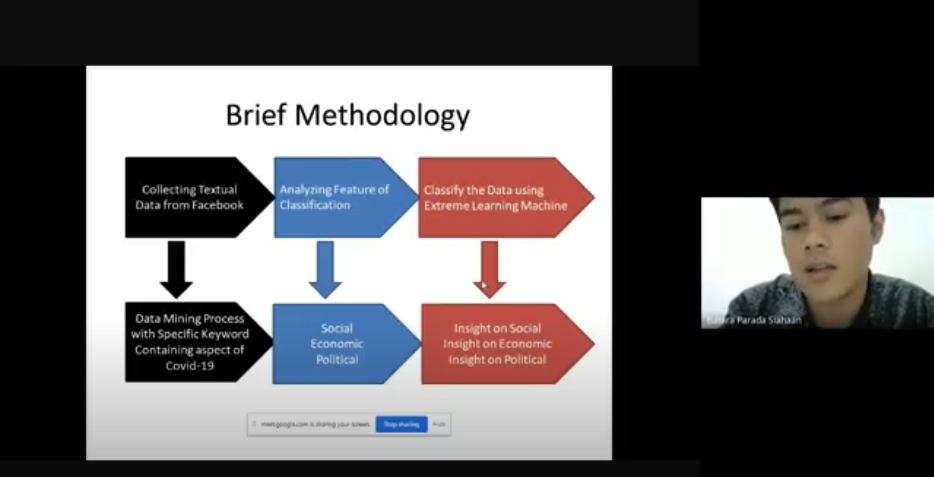
From the media monitoring, 1,540 data was obtained with 17,017 concepts (3,776 positive concepts, 6,498 neutral concepts, and 6,743 negative concepts) which provide the following insights. First, the discussion regarding businesses/UMKM/homestays that are losing money/bankrupt/out of business/affected by Covid is slowly decreasing. When viewed from a comparison of negative and positive sentiment, in 2022, it will start to decline, namely around 1.5: 1. Unlike the previous two years, the proportion of negative sentiment was 2 times more than positive sentiment. Second, the concept that appears most frequently is `UMKM.` This shows that the MSME sector was the news that existed during 2020-2022 related to the impact of covid/pandemic/etc, which caused the most losses/bankruptcy. Then, let’s look at sentiment distribution on the MSME concept. It shows that negative sentiment dominates other emotions, even neutral views.

Encouragement of Research Dissemination to the Public

After the explanation from the research team’s coordinator, the event continued with a question and answer session. Participants enthusiastically asked research questions to the speakers. This Knowledge Cafe event will likely increase the number of civitas researchers utilizing international research funds in the future. In addition, it is necessary for academics to regularly disseminate research to the public so that the intellectual benefits of developing knowledge can educate the nation’s life.

Anton Herutomo, doctoral student of SBM-ITB, opened the Q&A session
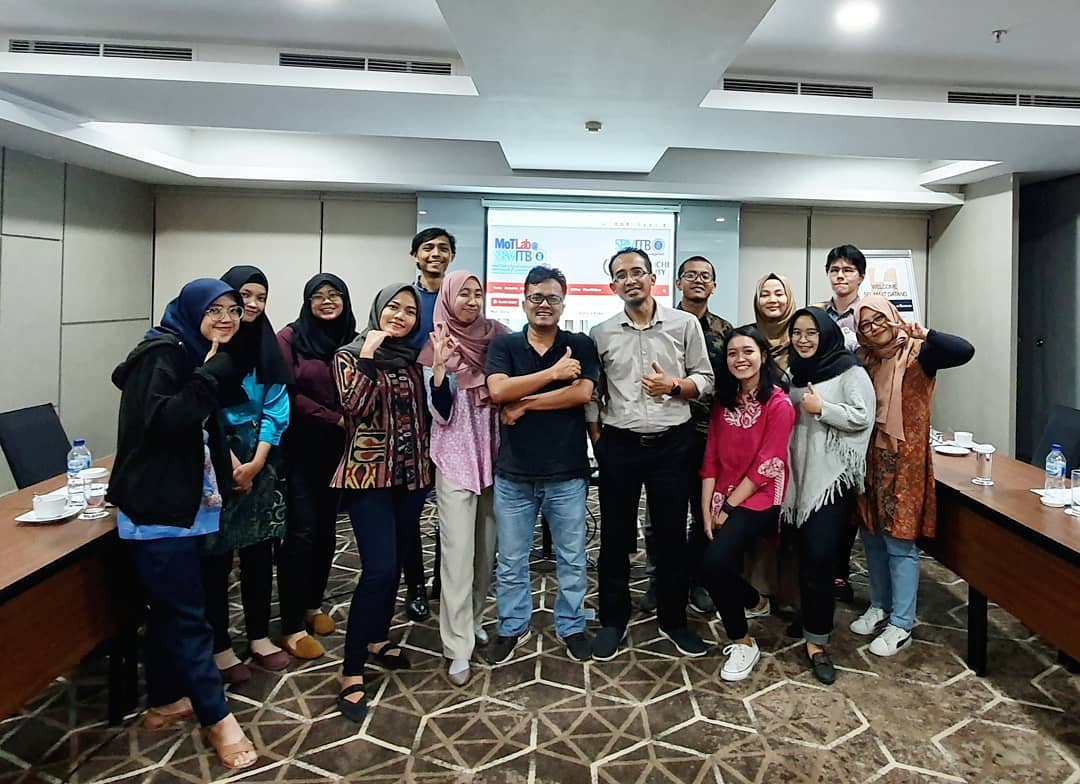
Photo session with the all participants

In particular, the Director of the MoT Lab, in his closing remarks, revealed that through this event, the researchers received input to further elaborate on the research that is currently being carried out. He also said that during the event, the speakers enjoyed the discussion process because this event was festive. “From this event, we get important things that will be elaborated in more detail for our research. We also enjoyed the discussion during this event“, said Dr.rer.pol. Eko Agus Prasetio.

This inaugural Knowledge Cafe was held in collaboration between community members and research assistants from the SBM-ITB MoT Lab, MSM-DSM Study Program, SBM-ITB Markom, SBM-ITB Sarpras, and sponsors, namely Facebook (Meta) and Golden Bridge Specialty Coffee.


Reported by: Uruqul Nadhif Dzakiy

Categories
Activities Seminar and workshop

5G Development in Indonesia: Some Lessons from MoT Lab SBM-ITB Webinar

Zoom: Management of Technology Laboratory (MoTLab) SBM ITB held a webinar on Wednesday (29/9/2021) with the theme “Framework for the Development and Application of 5G Technology in Indonesia”. The event, attended by hundreds of participants, was opened by the Deputy Dean for SBM academics, Prof. Aurik Gustomo. Dr. Eko Agus Prasetio, Head of MoTLab SBM-ITB, said that this webinar aimed to disseminate the dissertation research of  Sahat Hutajulu under supervision by Prof. Wawan Dhewanto and Dr. Eko Agus Prasetio. The event started with a keynote speech from the Secretary-General of the Ministry of Communication and Information of the Republic of Indonesia, Mira Tayyiba, ST., MSEE. He gave a presentation related to global 5G adoption and development statistics, the advantages of 5G, and the potential contributions, applications, and policies of 5G in Indonesia. The event then continued with presentations from three speakers: Dr. Eko Agus Prasetio, a lecturer at SBM-ITB and the Head of MoTLab SBM-ITB; Dr. Sahat Hutajulu, who is a graduate of DSM SBM-ITB, and Ir. Arief Mustin, MBA. who is Director & Chief Strategy and Innovation Officer of Indosat Oredoo. SBM-ITB lecturer Dedy Sushandoyo, Ph.D., moderated this event.
https://www.youtube.com/watch?v=y9fVHBhk5-E
Full documentation of webinar 5G SBM-ITB
5G Opportunities in Indonesia In her speech, Mira Tayyiba said that based on the LAPI ITB study in 2020, the potential for deploying 5G in terms of assets in Indonesia contributed more than IDR 2800 trillion or equivalent to 9.5% of the total national GDP in 2030 and will grow equal to IDR 3500 trillion or 9 % of GDP in 2035. With this contribution, the 5G network in Indonesia, she said, is still in the simultaneous use stage, namely complementing each other with the 4G network because the Government is still trying to spread 4G to 3T areas (4G for all). Until now, Kominfo has launched commercial operations of 5G networks in 9 regions in Indonesia since May 2021. On the regulatory side, the Government is currently establishing various regulations such as the Job Creation Law (UU No. 11 of 2020) with its derivative regulations and PP Postelsiar (Pos, telecommunications, and Broadcasting) or PP No. 46 of 2021. In addition, Kominfo and Commission 1 of the DPR-RI discuss drafting the Personal Data Protection Law (PDP).
Mira Tayyiba, ST., MSEE.
Development Framework The first speaker, Dr. Eko Agus Prasetio, said that the framework for developing 5G technology in Indonesia is based on the need to transfer 5G technology to Indonesia. It is further noted that the development of 5G requires an innovation ecosystem it. This 5G ecosystem involves far more players than 4G. Various technologies such as autonomous vehicles, agriculture 2.0, industry 4.0, remote surgery in the healthcare industry, which previously could not be done in 4G technology, make it possible to do in 5G technology. Even though the 5G opportunity is enormous, Indonesia faces various challenges such as high investment, disintegration with local governments, and limited creation, innovation, and development.
Dr. Eko Agus Prasetio
The second speaker, Dr. Sahat Hutajulu, conveyed the results of his research regarding how Indonesia could successfully develop this 5G technology. According to him, there are three phases of the 5G development strategy in Indonesia. The initial phase (investment & learning phase) will be more in the eMBB (enhanced mobile broadband) area. The second phase (work & reward phase) only focuses on mMTC (massive machine-type communications). Meanwhile, the last stage is reaping the benefits phase, namely by focusing more on URLLC (ultra-reliable and low latency communications).
Three-phase strategy of 5G Development in Indonesia
Sahat proposed a framework related to developing this 5G technology which consists of the Initiation stage, internalization stage, and generation/diffusion stage. The initiation stage is a 5G technology transfer from abroad. Then the first thing to do is to develop a scenario (scenarios development): the current strategy and the desired design in dealing with 5G (key drivers, trends, and uncertainties).
https://www.youtube.com/watch?v=NmleP6Vewrg
Dr. Sahat’s dissertation summary about 5G Development Framework
Then the internalization stage. From here, we deal with two things, namely tech commercialization and stakeholder collaboration in terms of infrastructure and indigenous co-creation ecosystem. Infrastructure is more emphasized on stakeholder’s collaboration because it seems more important. There are essential elements: government incentives, local government participation, MNO sharing, co-development, & co-innovation. In addition, it also emphasizes the commercialization of technology through indigenous co-creation ecosystems that build use cases & applications, complementary technology, innovation ecosystem, and market competition. The last stage is the generation/diffusion stage. Here the term diffusion performance is used. Simulations are also made in this research to illustrate how collaboration and commercialization of this technology affect diffusion performance. This diffusion performance indicator consists of the number of adopters (2 types of adopters being run: end-users in the form of people & industry), diffusion time, and total revenue/GDP.
The proposed framework of 5G development
Finally, Sahat revealed that the actions that can be taken are to have 5G labs, smart campuses, 5G innovation awards to answer social issues, diffusion performance dashboards, and regular events. 5G that Support Startups and SMEs Arief Mustain from Indosat Ooredoo discussed digital value creation by emphasizing the cellular industry during the pandemic and its challenges and the challenges and future strategies of the Telco industry, and the issue of 5G deployment. He said that digital value creation combines a digital infrastructure foundation, talent readiness, policy, regulation, and investment. On the infrastructure side, the urban market is oversupplied while the rural market has no supply even though competition requires infrastructure. He added that the Telco industry is faced with challenges, including investment. He said that there is no 5G without fiber. If there is no fiber, the traffic will be squeezed. Now it is still a challenge for fiber regulations; many local governments still create rules that do not support it. In addition, the Telco industry is also being challenged to reinvent itself.
Digital infrastructure foundation
Before the event closed, Prof. Wawan Dhewanto gave a closing remark. In his speech, he said that 5G technology is expected to support the business ecosystem in Indonesia, especially MSMEs for go-digital and startups. MSMEs will be able to apply a hybrid model by combining offline and online, and the existence of 5G will be able to make it grow, not only during the pandemic but also after the pandemic. “5G can support the development of the entrepreneurial ecosystem in Indonesia. Like only the application in the world of healthcare, transportation, it also accelerates MSME connections to go digital,” he said.

Reported by: Lely Trianti and Uruqul Nadhif

Categories
Activities

MoT Lab Held First Internship Program With BIOPS Agrotekno as Implementation of Living Lab Concept

BANDUNG, mot.sbm-itb.ac.id — Management of Technology Laboratory, School of Business and Management (MoT Lab SBM-ITB) held first internship collaborating with agro-technology startup BIOPS Agrotekno. The internship was attended by four MBA-ITB students for two months, from June to July 2021. The students are Mohammad Iqbal Ibrahim, Muhammad Nabil Ulwan, Nisaul Hasanah, and Yoel Iman. The internship was part of the implementation living lab concept. The laboratory activities are not limited to campus territory and make real-life in society a lab with its problems solved. The living lab involved the students by giving them direct experience to interact with the community. MoT Lab ran this concept collaborated with a startup, BIOPS Agrotekno.
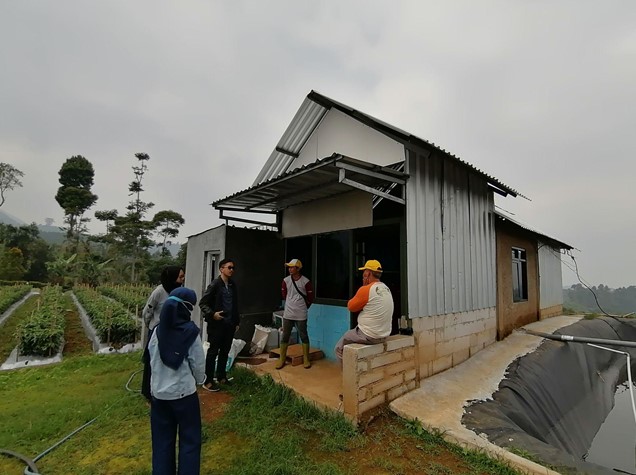
Field Visit with Pak Drajat in Cisarua
In this internship, the students identified opportunities for technology penetration in the agriculture sector in Northern and Southern Bandung, also opportunities for its business development. The agricultural technology here was an IoT-based automated plant watering system that a smartphone could control. The students helped BIOPS understand the characteristics of the farmers, the type of the plants, and the plant system in the observed territories. Then they tried to understand their problems related to its watering system and prove that BIOPS products can be a solution.
Formulation of market BIOPS proposed by the students
(source : biweekly report from the interns)
After understanding the characteristics of farmers, type of plants, and farming system in the field trip, the students recommended the marketing side for the BIOPS products in the future. They analyzed how BIOPS products can be used by owners of the farm around Bandung city then using social media platforms. “This internship was focused on the marketing side by looking for and meeting the farm owners around Bandung city by using social media platforms. Then we will contact, make the meeting, and analyze data to take actions“, said Yoel Iman, one of the interns.
Stage of creating marketing strategy for BIOPS designed by the students
(source : biweekly report from the interns)
The findings obtained from this internship were then reported by the students in the biweekly discussion (progress meeting). The session was moderated by Dr.rer.pol. Eko Agus Prasetio and Dedy Sushandoyo, Ph.D., as an academic advisor. BIOPS teams were also involved in the discussion as field advisors to monitor the progress and result of the internship for the future BIOPS. The internship was started with students’ registration to MoT Lab then the lab members gave an introduction and briefing. Then, the students did a field visit that consist of observation, interviewing, and introducing products. The output of the internship is a report whose chapters related to the process of apprenticeship from the beginning to the end, analysis, and recommendation for BIOPS as an industrial practitioner and ITB from the academics perspective.
Discussion and virtual biweekly meeting
An internship student, Yoel Iman, in an interview, said that the internship was interesting because there was an opportunity to meet new people and also to get a unique insight into the agriculture sector. “The interesting thing from this internship was the ability to meet many new people, and also we got new insight related to the agriculture sector,” he said.     —————————————————————————————————————————– This event also reported by several national medias : Kumparan https://kumparan.com/public-relation/mahasiswa-mba-itb-magang-bantu-petani-dalam-penerapan-teknologi-digital-agro-1wJkVzj2n3t/full Republika online https://www.republika.co.id/berita/qxqbmg349/mot-lab-sbm-itb-buat-program-magang-bantu-petani Bisnis Muda id https://bisnismuda.id/read/4068-don-cuan/kolaborasi-sbm-itb-startup-agro-petani-untuk-percepatan-teknologi-agro Pikiran Rakyat printed version 13 August 2021
Categories
Activities

Mot Lab or ITMEC (International Joint-Laboratory of Technology Management in Emerging Countries) Held a Meeting to Monitor Research Progress

Zoom (11/9/2020) – During the coronavirus pandemic, the Management of Technology Laboratory (MoT lab) held a virtual meeting to monitor research progress. The meeting was  special because it was attended by Prof. Matsuura from Yamaguchi University, Japan. Led by MoT Lab chairman Dr.rer.pol. Eko Agus Prasetio, the meeting took more than 3 hours. As a research centre in collaboration with Yamaguchi University, MoT Lab focuses on several research topics related to technology management and innovation with output such as journal articles, books, and a book chapter. The meeting started with a presentation from the research assistant to get some comments and feedback by the meeting members. For example, Alma Kenanga and Hakiim presented their research with the title “A Proposed Framework for Sustainable Government Policy in Industry 4.0 Implementation: Lesson-Learnt from Industry 4.0 Implementation in Indonesia”. Prof. Matsuura, Dr.rer.pol. Eko Agus Prasetio and Dedy Sushandoyo, Ph.D gave their comments and feedback so that they can improve the research and paper.