
Categories
Event News

Business Renewals as a Strategy for Indonesian State-Owned Enterprises to Face VUCA

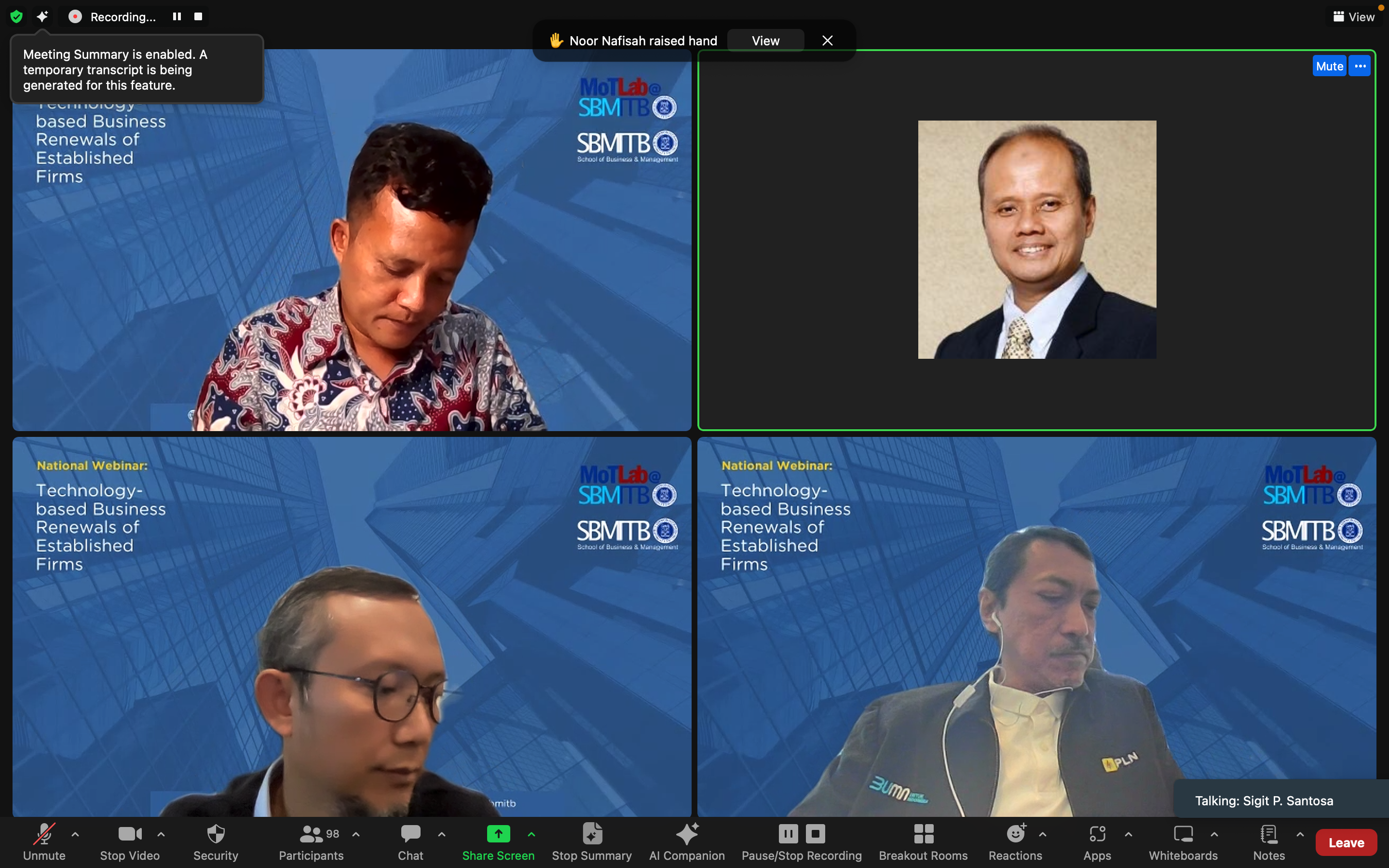
ZOOM– mot.sbm.itb.ac.id – As a response to State-Owned Enterprises (BUMN) in the technology sector facing conditions of volatility, uncertainty, complexity, and ambiguity (VUCA), they are implementing business renewal strategies by entering new fields outside their primary competencies. Interestingly, this strategy is implemented by several large state-owned companies in the energy, telecommunications, and defense sectors. Management of Technology Laboratory, School of Business and Management (MoT Lab SBM-ITB) responded to this condition by holding a national webinar with the theme “Technology-based Business Renewals of Established Firms” on Wednesday morning (6/12/2023) via the online platform Zoom. This event was attended by more than 170 participants.

This webinar presents top management from four state-owned companies, namely Sigit P. Santosa, Sc.D (Director of Technology and Development, PT Pindad), Oki Muraza, PhD (Senior Vice President Research, Technology and Innovation, Pertamina), Prasetiyo Raharjo, MT. (Tribe Leader Innovation Management, Telkom Indonesia), and Dr. Zainal Arifin (Executive Vice President of Renewable Energy, State Electricity Company (PLN)). Dedy Sushandoyo, PhD, Senior Lecturer at SBM-ITB and researcher at MoT Lab, moderated this event. The Dean of SBM-ITB, Prof. Pulung Nurprasetio, and Chair of the Innovation and Entrepreneurship Development Institute (LPIK-ITB) opened this webinar.

As the first speaker, Dr. Zainal Arifin from PLN revealed that PLN’s business renewals are carried out through exploitation and exploration strategies grouped into four sections: energy value providers, energy, home service providers, connected energy services, and beyond energy. One example of a program carried out by PLN is the construction of the Cirata PV Floating- 192 MW in the Cirata Reservoir, Purwakarta, West Java, the second largest PLTS in the world.

Second speaker from Telkom Indonesia

Prasetyo Raharjo, MT. from Telkom Indonesia, revealed that Telkom Indonesia implemented three strategies simultaneously: connectivity, platform, and service. One program Bernama Indigo runs is an external startup incubation for synergy and developing valuation. Telkom focuses on preparing digital talent and validating technology.

Because of VUCA, we are developing a new business model, so we focus on preparing digital talent and validating technology” said Prasetyo Raharjo.

Third speaker from Pertamina

In his presentation, Oki Muraza, Ph.D. from Pertamina, revealed that Pertamina combines three strategies at once: maintaining Indonesia’s energy independence, launching domestic resources for energy self-sufficiency, and an energy transition focused on net zero emissions. One example that Pertamina has carried out is R&D in developing red and white catalysts for biogasoline.

Keynote speaker from Director of Pindad

Sigit P. Santosa, Sc.D. from Pindad, revealed that VUCA encouraged PT Pindad to create something new and valuable through downstream and commercializing research results. He said that Pindad carried out technology push and market pull strategies in parallel by trying to go into detailed design, which resulted in an economic multiplier effect of up to 12 times. PT Pindad is currently thriving in making combat and tactical vehicles, of which the Maung 4 x 4 Merah Putih is the latest product.

Business innovation not only creates new products, but also new value through downstream and commercialization strategies”, said Sigit.

Dedy Sushandoyo, PhD. direct the discussion session

This event was closed by remarks by the Head of the SBM-ITB MoT Lab, Dr.rer.pol. Eko Agus Prasetio, MBA, with a question-and-answer session first.

Reporter: Uruqul Nadhif, MoT Lab SBM-ITB

Categories
Activities Seminar and workshop

Online Focus Group Discussion MoTLab-LPIK-ITB: Technology Commercialization Management in Higher Education

BANDUNG, mot.sbm.itb.ac.id – The Research, Innovation, and Commercialization Institute (LPIK) ITB, in collaboration with the Technology Management Laboratory at SBM ITB, conducted an online Focus Group Discussion on the theme of “Technology Commercialization Management in Higher Education.” The event took place on Wednesday, July 12, 2023, from 09:00 to 12:00 WIB (Indonesia time) via the Zoom Meeting platform, with live streaming available on the YouTube channel https://www.youtube.com/live/fRe9ZEpZAm0?feature=share.

The Focus Group Discussion featured relevant speakers, including the CEO of PT. Rekacipta Inovasi ITB, the Secretary of the Technology Transfer Department at LPIK ITB, the Commissioner of PT. Rekacipta Inovasi ITB, the Director of BPUDL-ITB, the Director of PUI UGM, the Head of LKST IPB University, inventors, investors (MDI Telkom), representatives from SMEs and startups such as Lintasarta and Kazee, large corporations (SOEs and private), as well as government representatives.

The event was opened by a representative from LPIK ITB, Mr. Arif Sasongko, who provided discussion materials regarding the importance of collaboration with industries and the need for research sandboxing. “Collaboration with industries and research sandboxing efforts are challenges that need to be discussed in this forum.”

Rofiq Iqbal, Ph.D., the Secretary of the Technology Transfer Department, LPIK ITB, presented the management of technology commercialization resulting from research at ITB through LPIK ITB.

The commercialization of technology is a crucial aspect of national progress. As research centers, higher education institutions have great potential to contribute through the commercialization of research products. However, continuous efforts are needed to improve the effectiveness of the commercialization process in higher education.

The Director of Agency for University Business and Endowment Fund Management (BPUDL) ITB, Deddy P. Koesridartoto, Ph.D.,  highlighted the overlapping schemes of campus research commercialization that need better orchestration. “Collaboration among research commercialization initiatives in ITB, as already carried out by PT. Rekacipta Inovasi ITB and LPIK, needs to be well-managed.”, said the Director.

Deddy P. Koesridartoto, Ph.D., the Director of BPUDL ITB, presented the role of BPUDL ITB in supporting technology commercialization at ITB.

During the event, discussions were initiated with narrations from actors or institutions involved in technology commercialization in higher education, including representatives from ITB, IPB, UGM, and responses from inventors, investors, industries, and companies.

Prof. Erika Budiarti Laconi, the Head of LKST IPB University, presented IPB University’s efforts in commercialization with a one-stop approach, where IPB facilitates all commercialization endeavors. “At IPB, no lecturer works alone; everything goes through LKST IPB University,” said Prof. Erika.

Dr. Hargo Utomo, the Director of PUI UGM, added that understanding market needs and behaviors is an important factor in commercialization efforts. “The commercialization of technological innovation relies more on the ‘art’ rather than the ‘science,’.”, said Dr. Hargo.

Prof. Erika Budiarti Laconi, Head of LKST, IPB University, presented the research commercialization management at IPB University.

In this Focus Group Discussion, valuable insights and solutions are expected to be obtained to enhance the effectiveness of technology commercialization in higher education, thereby positively impacting innovation progress in Indonesia. The moderator, Dedy Sushandoyo, Ph.D., from the MoT Lab made several notes. First, the importance of good governance and totality in technology commercialization management, the need to understand and follow market potential/demand, the importance of support for researchers, the need for a commercialization playbook, sandboxing in Science Techno Park, and sustainable cooperation and communication with industries.

Group photo of the Online Focus Group Discussion participants: Technology Commercialization Management in Higher Education.

Reporter: Anisa Azizah

Editor: Uruqul Nadhif

Categories
Research

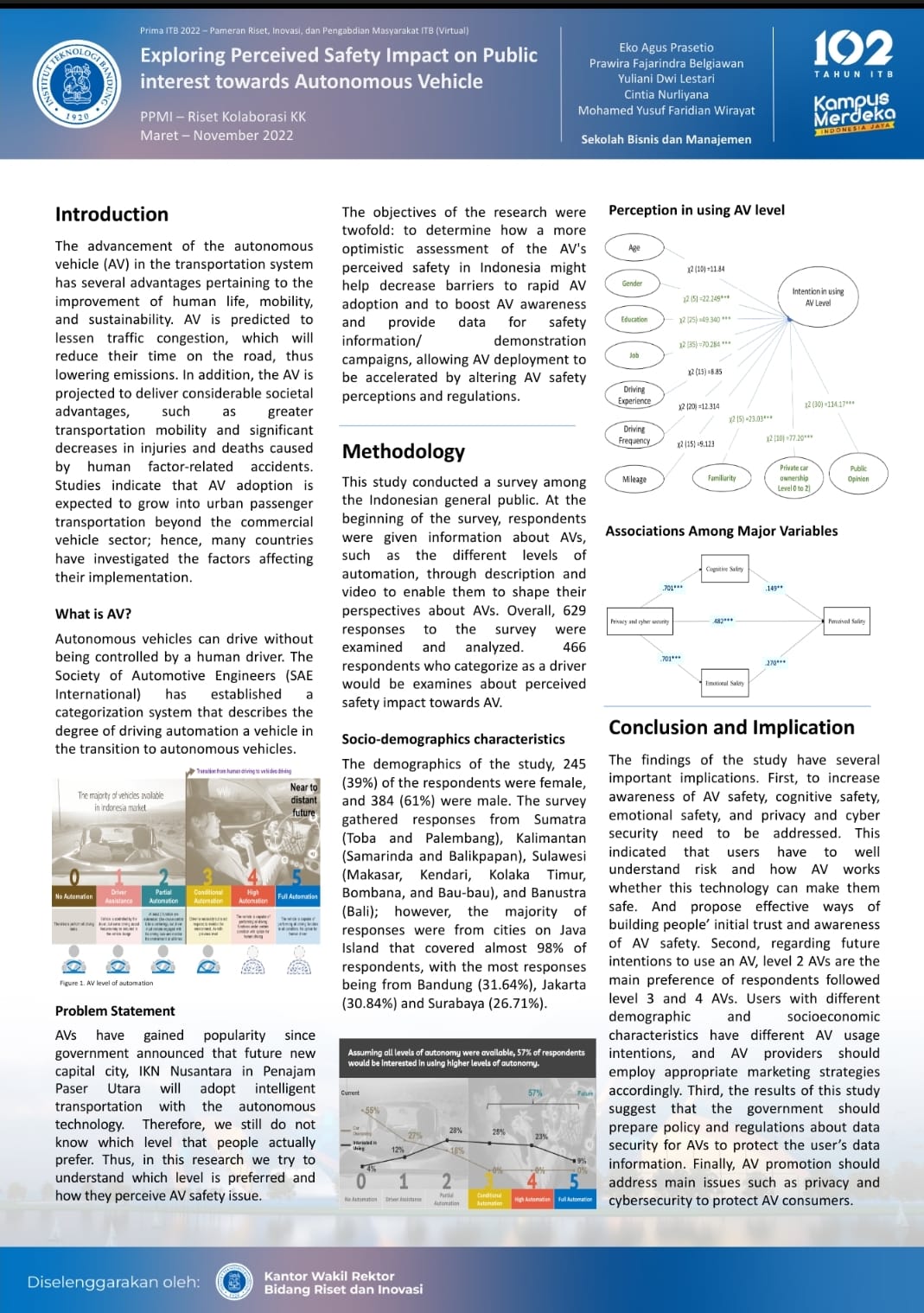
Understanding The Level of People Preference to Autonomous vehicle and Its Safety Issue

Autonomous vehicles (AV) can drive without being controlled by a human driver. Studies indicate that AV adoption is expected to grow into urban passenger transportation beyond the commercial vehicle sector; hence, many countries have investigated the factors affecting their implementation. AVs have gained popularity since the government announced that the future new capital city, IKN Nusantara in Penajam Paser Utara, will adopt intelligent transportation with autonomous technology.  Therefore, we still do not know which level people actually prefer. Thus, in this research, we try to understand the preferred level and how they perceive AV safety issues.

The objectives of the research are to determine how a more optimistic assessment of the AV’s perceived safety in Indonesia might help decrease barriers to rapid AV adoption and to, boost AV awareness, and provide data for safety information/ demonstration campaigns, allowing AV deployment to be accelerated by altering AV safety perceptions and regulations.

The description of the research was published in a poster in Pameran Riset, Inovasi, dan Pengabdian Masyarakat (PRIMA) ITB 2022 last 20 December 2022. The authors were Eko Agus Prasetio, Prawira Fajarindra Belgiawan, Yuliani Dwi Lestari, Cintia Nurliyana, and Mohamed Yusuf Faridian Wirayat. The research was conducted in collaboration with several Expertise Groups (KK) in the School of Business and Management ITB from March to November 2022. The poster’s title was “Exploring Perceived Safety Impact on Public Interest Toward Autonomous Vehicles.”

Survey to Indonesian General Public

This study surveyed the Indonesian general public. At the beginning of the survey, respondents were given information about AVs, such as the different levels of automation, through description and video to enable them to shape their perspectives about AVs. Overall, 629 responses to the survey were examined and analyzed.  466 respondents who categorize as a driver would be examined about the perceived safety impact of AV.

Of the demographics of the study, 245 (39%) of the respondents were female, and 384 (61%) were male. The survey gathered responses from Sumatra (Toba and Palembang), Kalimantan (Samarinda and Balikpapan), Sulawesi (Makasar, Kendari, Kolaka Timur, Bombana, and Bau-bau), and Banustra (Bali); however, the majority of responses were from cities on Java Island that covered almost 98% of respondents, with the most responses being from Bandung (31.64%), Jakarta (30.84%) and Surabaya (26.71%).

Conclusion

The findings of the study have several important implications. First, cognitive safety, emotional safety, privacy, and cyber security need to be addressed to increase awareness of AV safety. This indicated that users must understand risk, how AV works, and whether this technology can make them safe. And propose effective ways of building people’s initial trust and awareness of AV safety. Second, regarding future intentions to use an AV, level 2 AVs are the main preference of respondents, followed by level 3 and 4 AVs. Users with different demographic and socioeconomic characteristics have different AV usage intentions, and AV providers should employ appropriate marketing strategies accordingly. Third, the results of this study suggest that the government should prepare policies and regulations about data security for AVs to protect the user’s data information. Finally, AV promotion should address main issues such as privacy and cybersecurity to protect AV consumers.


Categories
Activities

MoT Lab Held First Internship Program With BIOPS Agrotekno as Implementation of Living Lab Concept

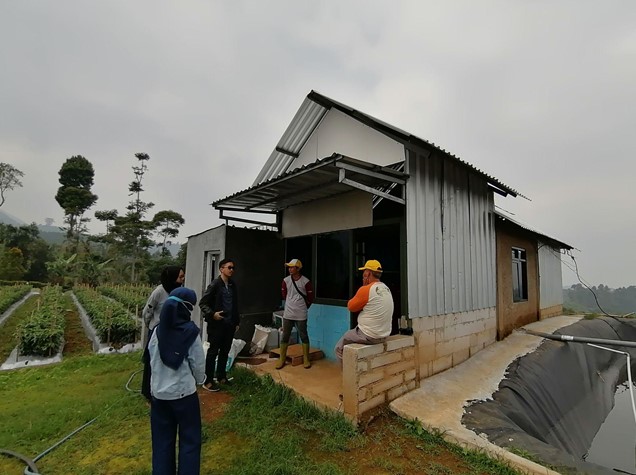
BANDUNG, mot.sbm-itb.ac.id — Management of Technology Laboratory, School of Business and Management (MoT Lab SBM-ITB) held first internship collaborating with agro-technology startup BIOPS Agrotekno. The internship was attended by four MBA-ITB students for two months, from June to July 2021. The students are Mohammad Iqbal Ibrahim, Muhammad Nabil Ulwan, Nisaul Hasanah, and Yoel Iman. The internship was part of the implementation living lab concept. The laboratory activities are not limited to campus territory and make real-life in society a lab with its problems solved. The living lab involved the students by giving them direct experience to interact with the community. MoT Lab ran this concept collaborated with a startup, BIOPS Agrotekno.
Field Visit with Pak Drajat in Cisarua
In this internship, the students identified opportunities for technology penetration in the agriculture sector in Northern and Southern Bandung, also opportunities for its business development. The agricultural technology here was an IoT-based automated plant watering system that a smartphone could control. The students helped BIOPS understand the characteristics of the farmers, the type of the plants, and the plant system in the observed territories. Then they tried to understand their problems related to its watering system and prove that BIOPS products can be a solution.
Formulation of market BIOPS proposed by the students
(source : biweekly report from the interns)
After understanding the characteristics of farmers, type of plants, and farming system in the field trip, the students recommended the marketing side for the BIOPS products in the future. They analyzed how BIOPS products can be used by owners of the farm around Bandung city then using social media platforms. “This internship was focused on the marketing side by looking for and meeting the farm owners around Bandung city by using social media platforms. Then we will contact, make the meeting, and analyze data to take actions“, said Yoel Iman, one of the interns.
Stage of creating marketing strategy for BIOPS designed by the students
(source : biweekly report from the interns)
The findings obtained from this internship were then reported by the students in the biweekly discussion (progress meeting). The session was moderated by Dr.rer.pol. Eko Agus Prasetio and Dedy Sushandoyo, Ph.D., as an academic advisor. BIOPS teams were also involved in the discussion as field advisors to monitor the progress and result of the internship for the future BIOPS. The internship was started with students’ registration to MoT Lab then the lab members gave an introduction and briefing. Then, the students did a field visit that consist of observation, interviewing, and introducing products. The output of the internship is a report whose chapters related to the process of apprenticeship from the beginning to the end, analysis, and recommendation for BIOPS as an industrial practitioner and ITB from the academics perspective.
Discussion and virtual biweekly meeting
An internship student, Yoel Iman, in an interview, said that the internship was interesting because there was an opportunity to meet new people and also to get a unique insight into the agriculture sector. “The interesting thing from this internship was the ability to meet many new people, and also we got new insight related to the agriculture sector,” he said.     —————————————————————————————————————————– This event also reported by several national medias : Kumparan https://kumparan.com/public-relation/mahasiswa-mba-itb-magang-bantu-petani-dalam-penerapan-teknologi-digital-agro-1wJkVzj2n3t/full Republika online https://www.republika.co.id/berita/qxqbmg349/mot-lab-sbm-itb-buat-program-magang-bantu-petani Bisnis Muda id https://bisnismuda.id/read/4068-don-cuan/kolaborasi-sbm-itb-startup-agro-petani-untuk-percepatan-teknologi-agro Pikiran Rakyat printed version 13 August 2021